No products in the cart.


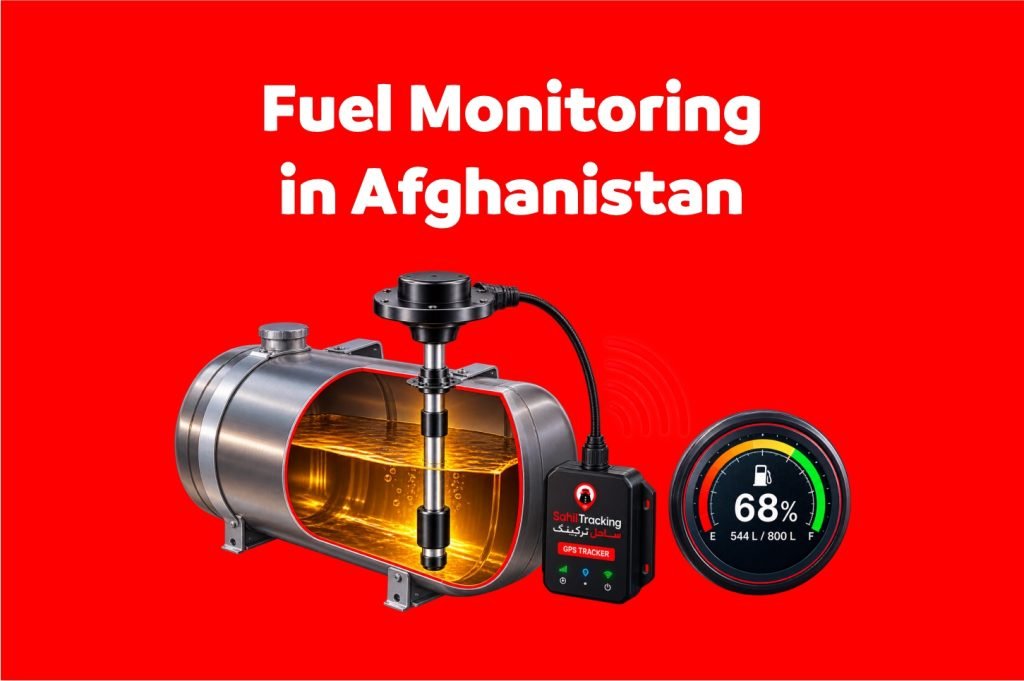
Generator fuel monitoring in Afghanistan helps organizations track diesel levels, understand consumption, verify refueling and investigate unexpected fuel losses. By connecting suitable sensors to a remote monitoring platform, managers can replace guesswork with a clearer record of what happens inside their generator fuel systems.
For a business operating one backup generator in Kabul, the immediate question may be simple: how much fuel is available before the next delivery? For an organization managing several provincial sites, the questions become broader. Which generator consumed the most diesel? Did the delivered quantity match the invoice? Was fuel transferred to another tank? How many hours did the equipment actually run?
These questions affect purchasing, maintenance, budgeting and service continuity. However, a tank gauge alone cannot answer all of them. An effective system must connect fuel measurements with generator activity, delivery records and the way each site operates.
This guide explains how generator monitoring works, which measurements matter, how to select equipment, what affects installation costs and how to turn fuel data into useful decisions.
What Is Generator Fuel Monitoring?
Generator fuel monitoring is the process of measuring and recording fuel-related activity around a generator. Depending on the installed equipment, it can show the fuel remaining in a tank, changes during refueling, estimated or directly measured consumption, engine running time and unusual fuel events.
Remote monitoring adds communication equipment and software. Instead of checking only a gauge beside the generator, an authorized manager can review readings and historical records through a connected platform.
There are three different questions to separate:
| Question | Useful measurement | Why it matters |
| How much diesel remains? | Calibrated tank volume | Plan the next delivery |
| How much did the engine consume? | Suitable flow measurement or reconciled tank data | Understand operating costs |
| Where did purchased fuel go? | Deliveries, transfers, consumption and closing stock | Investigate discrepancies |
A system designed around these questions is more useful than a dashboard filled with numbers that nobody reviews.
Why Generator Fuel Monitoring in Afghanistan Matters
Organizations using diesel generators need reliable fuel records whether the equipment supplies backup power or operates for longer periods. The challenge grows when the person approving purchases is far from the person receiving deliveries.
Consider a company with a central office in Kabul and several field locations. Each site may submit fuel receipts and handwritten running-hour records. Those documents provide a starting point, but they may not show when fuel entered a tank, whether a transfer occurred or whether the generator ran during the reported period.
Remote measurements can help connect these records. They also make it easier to identify missing information before it becomes a month-end accounting problem.
Avoiding unexpected low-fuel situations
A tank that appeared sufficient yesterday may not be sufficient today if operating hours increase. Low-fuel alerts and recent consumption trends help staff plan deliveries using current information.
Delivery planning should include travel time, supplier availability and a reserve. A reading on a dashboard does not replace an agreed procedure for responding to an alert.
Checking deliveries more consistently
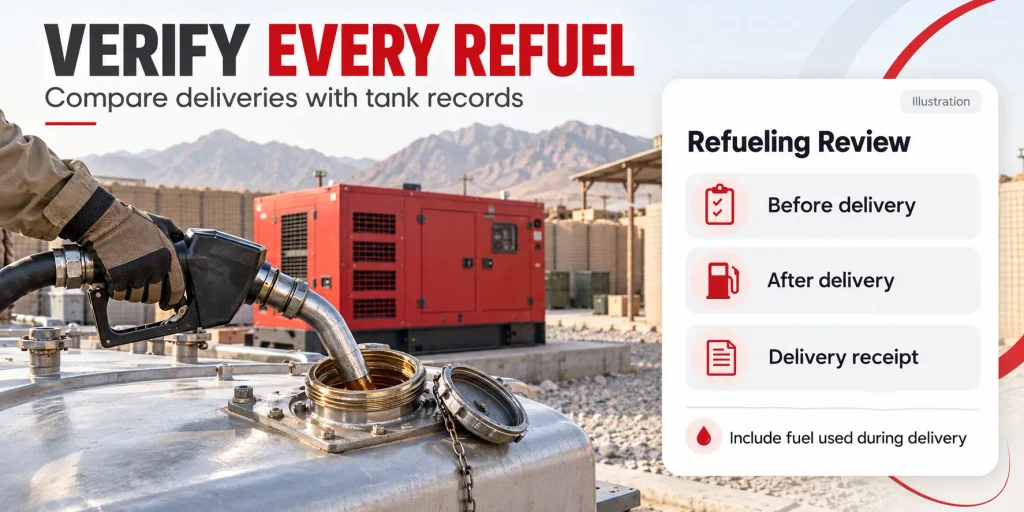
An invoice states what was billed. A tank measurement indicates the change in stored volume. Comparing these records can reveal differences that deserve review.
However, measurement conditions matter. If the generator runs during delivery, the net tank increase will be smaller than the delivered amount. A fair reconciliation must account for fuel consumed or transferred during the same period.
Improving accountability without guesswork
A sudden fuel drop can justify an investigation, but it does not automatically prove theft. Authorized transfers, leaks, maintenance work and sensor problems can also create unusual readings.
Good monitoring creates evidence for a careful review. It should help managers ask better questions rather than make unsupported accusations.
How a Generator Fuel Monitoring System Works
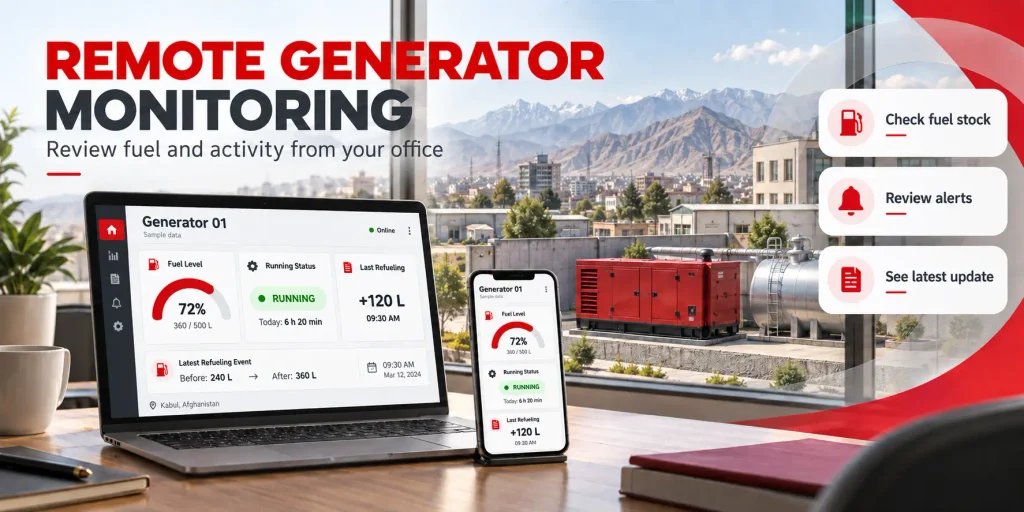
A typical installation combines measurement equipment, a communication device and monitoring software. The exact design depends on the generator, fuel tanks and reporting requirements.
First, sensors collect readings. A fuel level sensor measures the level in a tank. A suitable flow meter measures fuel movement through the engine fuel system. Other inputs may indicate generator running status or electrical output.
Next, a compatible gateway collects these signals. It can send readings to a platform over an available communication connection. Some equipment can also store records locally during an interruption, but this capability must be confirmed before purchase.
Finally, the platform organizes the information into charts, reports and alerts. Managers can compare fuel changes with runtime and delivery events.
Sahil Tracking’s fuel monitoring services describe remote fuel-level visibility, refueling records and review of unusual fuel changes for generators and other assets. The equipment and reporting available for an individual project should be agreed during the site assessment. sahiltracking.com
Fuel Level Sensors vs. Fuel Flow Meters
Choosing the right measurement method is one of the most important decisions in generator fuel monitoring in Afghanistan. A fuel level sensor and a fuel flow meter solve different problems.
Fuel level sensors: monitoring stored diesel
A fuel level sensor measures the level inside a tank. With a suitable calibration, the system converts the reading into an estimated volume in liters.
This is useful for monitoring remaining stock and identifying increases or decreases in tank volume. However, a falling level alone cannot distinguish engine consumption from every other reason fuel might leave the tank.
Fuel flow meters: monitoring engine fuel use
A suitable fuel flow meter measures fuel moving through the engine’s fuel lines. On diesel systems with a return line, the installation must account for fuel returning to the tank. Measuring only supply flow can overstate actual engine consumption.
Technoton’s generator case describes a differential arrangement measuring supply and return flows. Its technical comparison also distinguishes tank inventory measurement from direct measurement in engine fuel lines. JV Technoton
Combining the two methods
Tank monitoring can answer how much fuel remains. Appropriate flow measurement can answer how much the engine used. Using both can strengthen reconciliation, especially when a site needs to separate consumption from transfers and other losses.
| Method | Main purpose | Main limitation |
| Calibrated fuel level sensor | Track tank stock, refills and drops | Tank changes need operational context |
| Suitable fuel flow meter | Measure engine fuel use | Does not automatically show tank stock |
| Compatible generator controller data | Read supported runtime or operating information | Available parameters vary by controller |
| Combined system | Link inventory with engine activity | Requires careful integration and validation |
For a small site, a simpler installation may be enough. For a high-consumption site with strict reporting needs, additional measurements may justify the investment.
Tank Calibration: Why Liters Must Be Verified
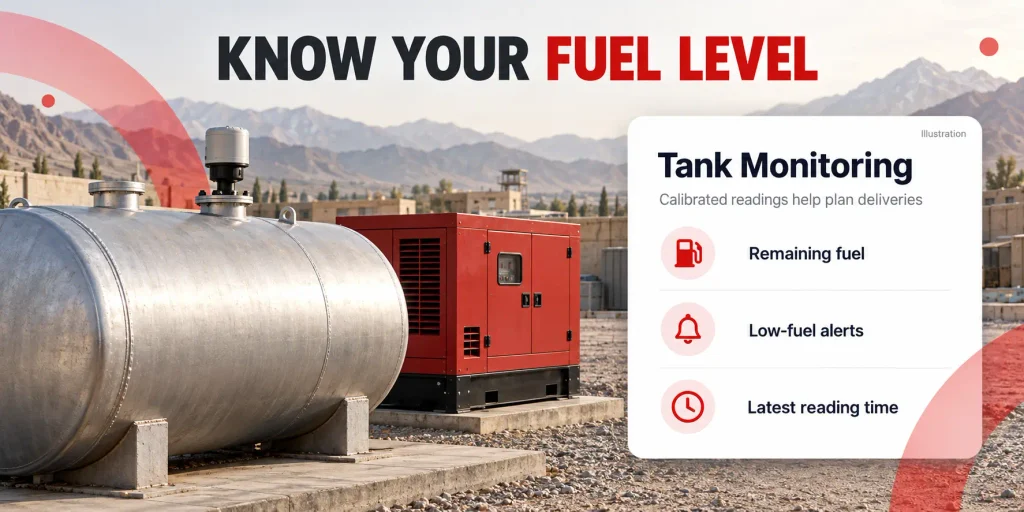
A fuel sensor reading is only useful if it relates correctly to the tank being measured. Tank shape, mounting position and usable capacity can affect that relationship.
For example, a horizontal cylindrical tank does not hold the same number of liters in every equal increase in depth. A percentage reading therefore needs a valid conversion before it can be treated as an inventory figure.
During commissioning, the installer should establish a documented relationship between sensor readings and known fuel volumes. The procedure must suit the sensor and tank design. Managers should retain the calibration record rather than rely only on the final dashboard display.
Ask the installer to explain:
- How tank volume was established.
- Which reference measurements were used.
- What operating range was tested.
- Which parts of the tank cannot be measured reliably.
- How the installed accuracy will be checked later.
Do not assume that a sensor’s laboratory specification guarantees the same accuracy for the entire installed system. The meaningful figure is the performance demonstrated under the site’s actual conditions.
Bulk Storage Tanks and Generator Day Tanks
Many generator installations involve more than one tank. Fuel may arrive in a bulk storage tank, move into a smaller day tank and then feed the generator.
This creates an important accounting issue. A drop in the bulk tank may represent an authorized transfer rather than engine consumption. Similarly, a rise in the day tank may represent an internal transfer rather than a new supplier delivery.
For useful reporting, identify every tank and define the monitored boundary. Decide whether reports cover one tank, one generator or the whole site.
For example, suppose 200 liters move from a site’s bulk tank to its day tank. The bulk tank decreases by 200 liters and the day tank increases by 200 liters. If both tanks are inside the reporting boundary, total site inventory has not changed because of that transfer.
A system that records only the bulk tank could misclassify this event unless transfer information is added. Mapping the fuel path before installation prevents this kind of confusion.
How to Calculate Generator Fuel Consumption
Consumption calculations should clearly state what was measured and what was estimated. A monthly fuel invoice alone is not a measurement of engine consumption because some of the purchased fuel may remain in storage.
Fuel balance for a defined period
A practical reconciliation is:
Opening stock + deliveries + transfers in − closing stock − transfers out = fuel depletion within the monitored boundary.
Fuel depletion can include engine consumption and unexplained losses. To separate them, compare the balance with direct consumption measurements and documented events where available.
For example, assume a monitored tank starts with 800 liters. It receives 400 liters, ends with 650 liters and transfers 50 liters to another tank outside the reporting boundary.
800 + 400 − 650 − 50 = 500 liters of depletion.
That figure is not automatically proof that the generator burned 500 liters. It still needs to be compared with engine operation and any known drainage, leakage or measurement uncertainty.
Average consumption per running hour
Once engine consumption is established:
Average liters per hour = engine fuel consumed ÷ generator running hours.
If an engine uses 360 liters over 30 running hours, its average for that period is 12 liters per hour. This is a historical average, not a universal consumption rate for every generator of the same size.
Fuel used per unit of electricity
If reliable electrical energy measurements are also available:
Liters per kWh = engine fuel consumed ÷ electricity generated in kWh.
For example, 360 liters used to generate 1,200 kWh gives 0.30 liters per kWh. This can help compare similar operating periods, provided both measurements cover the same timeframe.
Generator nameplate capacity is not actual energy production. A 100 kVA rating alone cannot tell you how many kWh the equipment generated or how much diesel it should have used.
Understanding Load Before Comparing Generators
Two generators with similar ratings may show different average fuel use because they operated under different loads or for different purposes.
One may supply a few essential devices during short interruptions. Another may power a busy facility for long periods. Comparing their total monthly liters without considering output and runtime can produce a misleading conclusion.
Caterpillar’s published generator data lists fuel consumption at specified load levels, illustrating why load matters when assessing expected use. Use the data for the actual generator model rather than a generic internet estimate. emc.cat.com
A practical comparison should consider the equipment model, operating hours, measured load where available, service condition and the same reporting period. If electrical output is unavailable, acknowledge that limitation in the report.
Monitoring can reveal an unusual trend. A qualified generator technician should determine whether it reflects changing demand, maintenance needs or another cause.
Alerts That Help Staff Take Action
Alerts work best when each one has a clear owner and response procedure. Sending every event to every employee can create noise and reduce attention to the important ones.
Low-fuel alerts
Set thresholds using usable stock, recent consumption and delivery lead time. A fixed percentage may be insufficient for sites with very different operating patterns.
For illustration, if usable fuel above the reserve is 240 liters and recent consumption is 12 liters per hour, estimated runtime before reaching that reserve is 20 hours. Increased load may shorten this estimate.
Unusual fuel-drop alerts
Review the size and duration of a drop alongside running status and authorized transfers. Settings should allow for normal measurement variation and be validated during commissioning.
Refueling events
Capture before-and-after readings and compare them with delivery records. If the engine ran during the event, include that activity in the reconciliation.
Stale-data alerts
Managers need to know whether they are seeing a current reading or the last reading received several hours ago. Displaying a timestamp helps prevent false confidence during a connection problem.
Runtime and service reminders
Where supported, running-hour records can help plan maintenance. Use the generator manufacturer’s service requirements and confirm that the selected input represents actual engine operation.
Investigating Suspected Fuel Loss
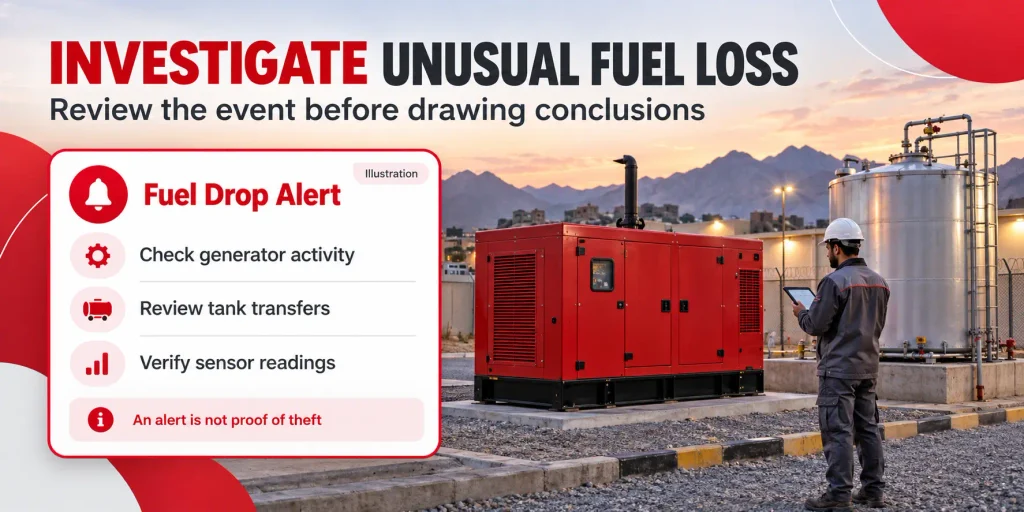
Start with the facts. Note the event time, measured volume change, generator state and whether staff recorded a delivery or transfer.
Next, review whether readings were stable before and after the event. A communication interruption or sensor issue may require a technical check before the figures can support a conclusion.
Then compare the event with delivery documents, maintenance activity and staff explanations. Where site access records exist, they may provide additional context.
Finally, document the result. Classify the event as an authorized activity, measurement issue, confirmed loss or unresolved discrepancy. This gives the organization a defensible record and helps improve future alert settings.
Physical controls still matter. A monitoring system should support existing tank access procedures, fuel issue records and site supervision.
Who Can Benefit From Generator Fuel Monitoring?
NGOs and field offices
Organizations with several locations can use consistent fuel records to review spending by site or project. Reports should distinguish verified consumption from estimates and retain supporting delivery documents.
For wider asset oversight, see Sahil Tracking’s NGO fleet management guide.
Construction companies
A construction site may manage stationary generators alongside trucks and heavy equipment. Generator reporting should use running hours and suitable fuel metrics rather than vehicle distance alone.
Combining asset oversight can support a clearer project budget. Read the construction GPS tracking guide for the wider fleet context.
Hospitals and clinics
Facilities using backup power need clear responsibility for fuel readiness. Monitoring can support delivery planning, but operational decisions must follow the facility’s procedures and the generator’s approved controls.
Telecom sites and distributed facilities
Remote sites benefit from clearly timestamped readings and defined procedures for communication interruptions. Connection availability should be tested at the actual equipment location.
Hotels, factories, banks and office compounds
Fuel reporting can help managers understand the cost of backup power and compare purchasing records with equipment activity. Sites with several generators should identify which tank supplies each unit before drawing conclusions about individual consumption.
Installation and Commissioning Checklist
A successful project begins with a site survey. Share the generator model, tank sizes, photographs, fuel-system layout and the reports you need.
The assessment should identify measurement points, available interfaces, communication options and installation constraints. It should also distinguish essential features from optional additions such as electrical metering or controller integration.
Installation should follow the equipment manufacturers’ requirements and approved site procedures. Changes to tanks, fuel lines or electrical systems require competent personnel and an agreed installation method.
Before accepting the system, verify these items:
| Acceptance item | Practical check |
| Asset identity | Correct site, tank and generator labels |
| Tank measurement | Readings checked against documented reference volumes |
| Runtime | Engine start and stop reflected correctly |
| Refueling | Known delivery recognized and recorded |
| Transfers | Internal movements classified correctly |
| Alerts | Test events reach the assigned recipient |
| Connectivity | Latest timestamp and interruption behavior checked |
| Reports | Units, time zone and reporting periods confirmed |
| User access | Staff see only the information they need |
A working login is not the same as a validated installation. Acceptance should show that the system records the site’s real activities correctly.
Generator Fuel Monitoring Costs in Afghanistan
Generator fuel monitoring costs depend on the scope of the installation. One tank with a fuel level sensor requires a different budget from several tanks with flow measurement, controller integration and detailed reporting.
Request a quote that separates hardware, installation, calibration, connectivity, platform charges, training and ongoing support. Ask whether replacement visits and future recalibration are included.
The cheapest quote may omit a measurement you need. Conversely, an expensive installation may include features that do not improve your decisions. Compare offers against a written list of required reports and acceptance checks.
Do not use a universal price without a site assessment. Tank access, fuel-system design and the number of monitored assets can change the amount of work substantially.
An Illustrative Fuel Cost and Payback Example
The following numbers are hypothetical. They are not current Afghan diesel prices, a Sahil Tracking quotation or a promised result.
Suppose a site uses 2,400 liters each month at an assumed cost of AFN 70 per liter. Monthly fuel expenditure is:
2,400 × 70 = AFN 168,000.
If verified operational improvements reduce avoidable use or losses by 120 liters per month, the gross saving under the same assumed price is:
120 × 70 = AFN 8,400 per month.
Assume monitoring and connectivity cost AFN 1,500 per month. Net monthly savings would be AFN 6,900. If the initial installation cost were AFN 45,000, simple payback would be approximately:
45,000 ÷ 6,900 = 6.5 months.
Actual results depend on measured improvements and the real costs of the project. If there is no verified reduction, this savings-based calculation does not apply. Better reporting and earlier delivery planning may still offer value, but they should be assessed separately.
Turning Reports Into Better Decisions
Monitoring creates value when someone reviews the data and acts on it. Start with a short daily check: current stock, latest timestamp, unresolved alerts and upcoming deliveries.
Each week, compare delivered fuel with recorded stock increases. Review unexplained events and identify sites needing a technical check. Compare consumption with operating hours and output where available.
At month-end, reconcile opening stock, deliveries, transfers and closing stock. State which consumption figures were directly measured and which were calculated. Keep corrections visible so later reviewers understand why a number changed.
An effective monthly report should include asset identity, fuel received, fuel remaining, runtime, consumption method, unresolved discrepancies and actions taken. For each important exception, assign an owner and a completion date.
Organizations managing mobile assets can connect generator reporting with broader fleet management services, while preserving the different metrics each asset requires.
Common Mistakes to Avoid
Treating every fuel drop as theft creates unnecessary disputes. Treating every invoice as proof of consumption creates unreliable budgets. Both mistakes come from using one record to answer a question it cannot fully resolve.
Other problems include skipping tank calibration, measuring supply flow without accounting for return fuel, ignoring internal transfers and comparing generators under different loads.
A final mistake is collecting data without a response process. Assign responsibility for alerts, report review and sensor checks before rollout. Otherwise, the dashboard may become another screen that staff rarely open.
Generator Fuel Monitoring With Sahil Tracking
Sahil Tracking provides fuel monitoring services that can support organizations operating generators and other fuel-consuming assets. A project should begin by identifying the questions your team needs to answer and confirming the measurements required.
Prepare details of your sites, generators, tanks, approximate running hours and existing records. Explain whether your priority is low-fuel visibility, delivery verification, consumption reporting or investigation of unusual losses.
Then agree on the equipment, reports, alert responsibilities and acceptance checks before installation. This makes the proposed solution easier to assess and gives both teams a clear definition of success. To discuss generator fuel monitoring in Afghanistan, contact Sahil Tracking for a site-specific assessment.
Frequently Asked Questions
What is generator fuel monitoring in Afghanistan?
It is the measurement and recording of generator fuel activity, including tank levels, refueling, consumption and unusual losses. A remote system sends supported readings to a platform that authorized staff can review.
Can a GPS tracker alone measure diesel in a generator tank?
GPS location alone cannot measure fuel. The installation needs a suitable fuel sensor, flow meter or compatible data source, plus equipment that can receive and transmit those readings.
Can I monitor several generators from one platform?
Yes, with a compatible system designed for multiple assets. Each generator and tank should have clear identification, appropriate measurements and suitable access permissions.
Does a sudden drop prove fuel theft?
No. A drop can also result from an authorized transfer, leakage, maintenance or measurement problems. Review the event alongside generator activity and site records.
Can the system work during an internet interruption?
Some devices can store readings and upload them later. Confirm that the selected equipment supports this behavior. Remote live visibility depends on an available communication connection, and old readings should display their timestamp.
How accurate is generator fuel monitoring?
Accuracy depends on the sensor, installation, calibration and operating conditions. Ask for a documented acceptance test rather than relying only on a general product claim.
How much diesel should my generator use per hour?
Use the actual model’s manufacturer data at the relevant load, then compare it with measured operation. A single consumption figure cannot apply to every generator of the same nominal capacity.
Can fuel monitoring show electrical efficiency?
Fuel data alone does not show electrical efficiency. Reliable fuel consumption and electrical energy measurements over the same period can support a liters-per-kWh calculation.
Is remote generator shutdown included?
Fuel monitoring does not automatically include remote control. Any start or stop function requires a separately assessed controller integration, approved permissions and site-specific operating procedures.
What determines the price?
The number of tanks and generators, measurement methods, integration work, calibration, installation conditions, connectivity and ongoing support determine the scope and price.
What information should I send for a quotation?
Send the generator model, tank capacity, site location, equipment photographs, fuel-system layout if available and the reports you need. Include the number of assets and any existing sensors or controllers.
Can monitoring reduce fuel costs?
It can reveal avoidable operation, delivery discrepancies and unusual losses. Savings depend on what the organization identifies and corrects; the equipment alone does not guarantee a percentage reduction.